Select appropriate raw materials. For threaded cross - pieces, commonly used materials include carbon steel, alloy steel, stainless steel (such as 304, 316). The blank should be a rolled profile, like bars, thick - walled pipes or plates. If using steel ingots as raw materials, the steel ingots should be rolled into bars or forged first to eliminate defects such as segregation and porosity in the steel ingots. 2. Heating
Heat the prepared blank to an appropriate forging temperature. The specific temperature depends on the material of the blank. For example, for carbon steel, the forging temperature is generally between 800 - 1250 °C. Proper heating can improve the plasticity of the metal and facilitate subsequent forging operations.
3. Die Forging
3.1 Initial Forging (Optional)
Put the heated blank into the forging die. Depending on the situation, initial forging may be carried out first to roughly shape the blank, so that it is closer to the shape of the final die - forging die cavity, which helps to ensure that the subsequent die - forging process can be carried out smoothly.
3.2 Die Forging
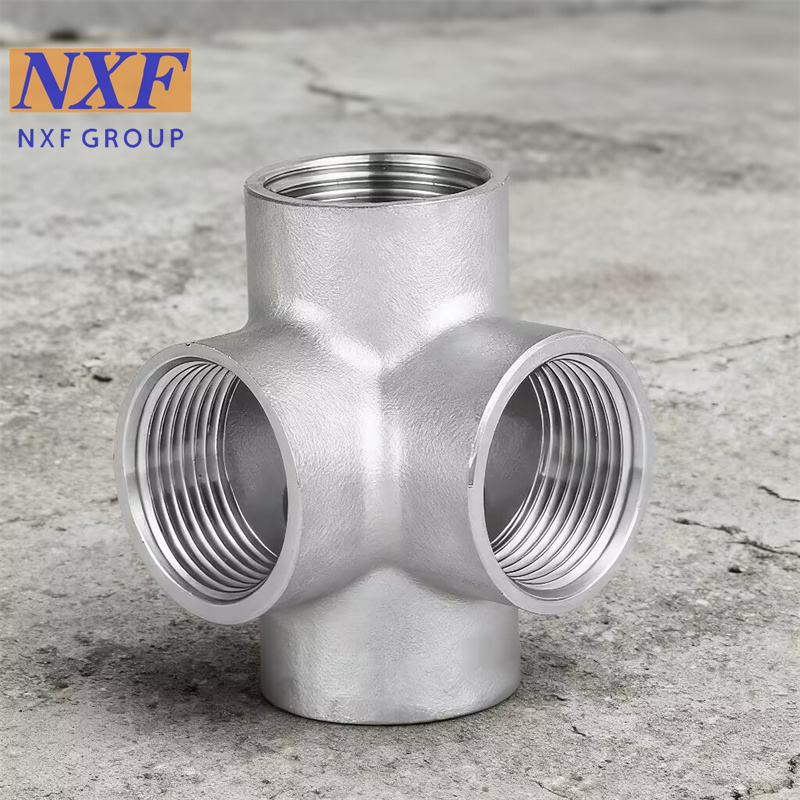
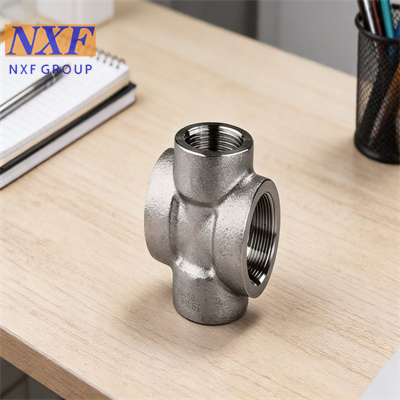
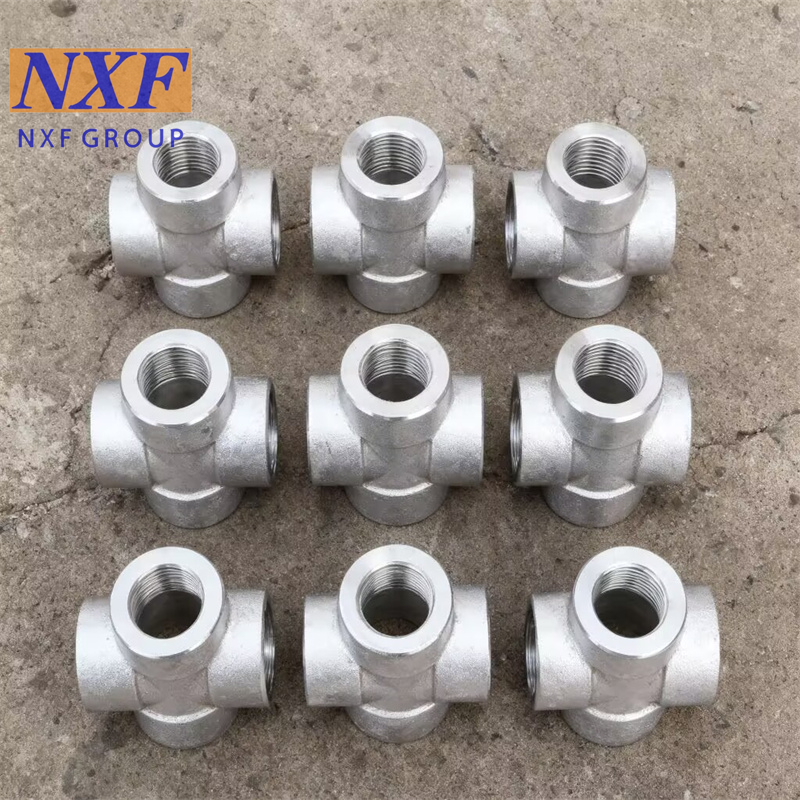
Then perform die forging. Under the action of pressure, the metal flows and fills the die cavity. The forging equipment (such as a forging press) applies a certain pressure to make the blank deform according to the shape of the die cavity, gradually forming the shape of the threaded cross - piece, including the shape of the four ports and the overall structure.
4. Trimming
After die forging, if there are flash residues on the blank, a trimming process is required. Use a trimming die or other equipment to remove the flash around the forged blank, so that the shape of the threaded cross - piece is more regular and meets the subsequent processing requirements.
5. Machining
5.1 Thread Processing
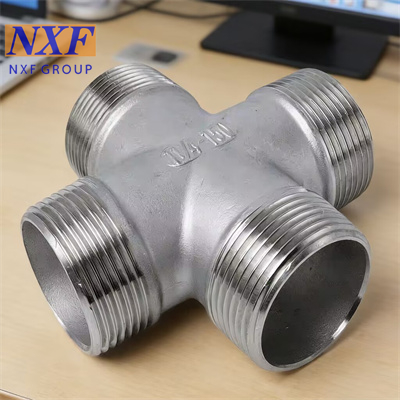
Process threads at the ports of the cross - piece. This can be done by using thread - cutting tools (such as taps for internal threads) on a lathe or special threading equipment. For external threads, threading dies or thread - milling processes can be used to ensure that the thread size and accuracy meet the design requirements (such as thread pitch, thread depth, and thread form).
5.2 Dimensional Finishing
Perform finishing operations on other dimensions of the cross - piece, such as machining the outer surface, end faces, etc., to ensure that the overall dimensions (such as length, outer diameter, wall thickness) of the cross - piece meet the design and technical specifications.
6. Heat Treatment
Carry out heat treatment processes according to the material and performance requirements of the threaded cross - piece. For example: - Annealing: It can reduce the hardness of the cross - piece, eliminate internal stress, and improve machinability. For some steels, the annealing process is carried out at a specific temperature (such as 600 - 700 °C for carbon steel) and then slowly cooled. - Quenching and Tempering: Improve the comprehensive mechanical properties of the cross - piece, such as strength, toughness, and hardness. First, quench (heat the cross - piece to a certain
temperature, such as 800 - 900 °C for carbon steel, and then quickly cool it in a quenching medium like water or oil), and then temper (heat to a lower temperature, such as 500 - 600 °C, and then cool) to adjust the performance.
7. Surface Treatmen
7.1 Cleaning
Clean the surface of the threaded cross - piece to remove oil stains, oxide scales, etc. generated during
processing. Methods such as chemical cleaning (using cleaning agents) or mechanical cleaning (such as sandblasting) can be used.
7.2 Anti - corrosion Treatment (Optional)
If the threaded cross - piece is used in a corrosive environment, anti -corrosion treatment is required. For example: - Galvanizing: For carbon steel cross - pieces, galvanizing (hot - dip galvanizing or electro - galvanizing) can be carried out to form a zinc - based protective film on the surface to improve corrosion resistance. - Passivation: For stainless steel cross - pieces, passivation treatment can be carried out to form a passive film on the surface, enhancing the corrosion resistance of stainless steel.
8. Quality Inspection
8.1 Dimensional Inspection
Use measuring tools (such as calipers, micrometers, thread gauges) to inspect the dimensions of the threaded cross - piece,including the diameter of the ports, the pitch and size of the threads, the overall length and outer diameter of the cross - piece, etc., to ensure that they meet the design drawings.
8.2 Material and Mechanical Property Inspection
- Material Composition Analysis: Use methods such as spectral analysis to check whether the material composition of the cross - piece meets the requirements. - Mechanical Property Testing: For example, conduct tensile tests, hardness tests on sample parts to verify whether the strength, hardness and other mechanical properties meet the standards.
8.3 Appearance and Defect Inspection
Check the appearance of the cross - piece for cracks, sand holes, burrs and other defects. Methods such as visual inspection, magnetic particle inspection (for ferromagnetic materials), and penetrant inspection can be used to detect surface and near -surface defects.
9. Packaging and Storage
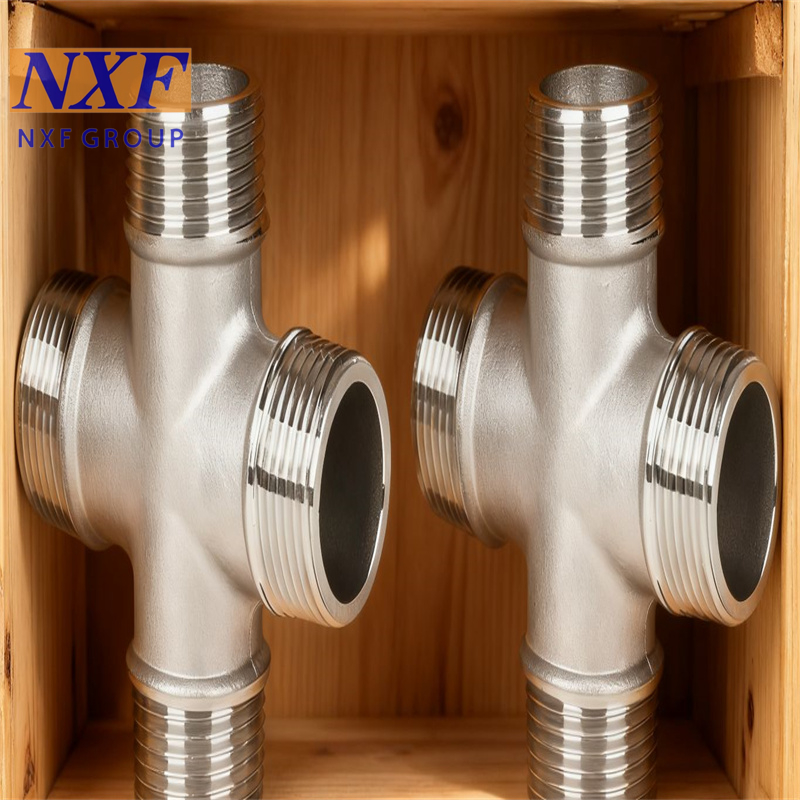
After passing the inspection, package the threaded cross - pieces. Use appropriate packaging materials (such as anti - rust paper, plastic film, wooden cases) to protect the cross - pieces from damage
and corrosion during storage and transportation. Then store the packaged cross - pieces in a suitable warehouse, paying attention to the storage environment (such as temperature, humidity, ventilation) to ensure the quality of the products.






total 0 Sheet,Only 5 images can be uploaded, each less than 5m.