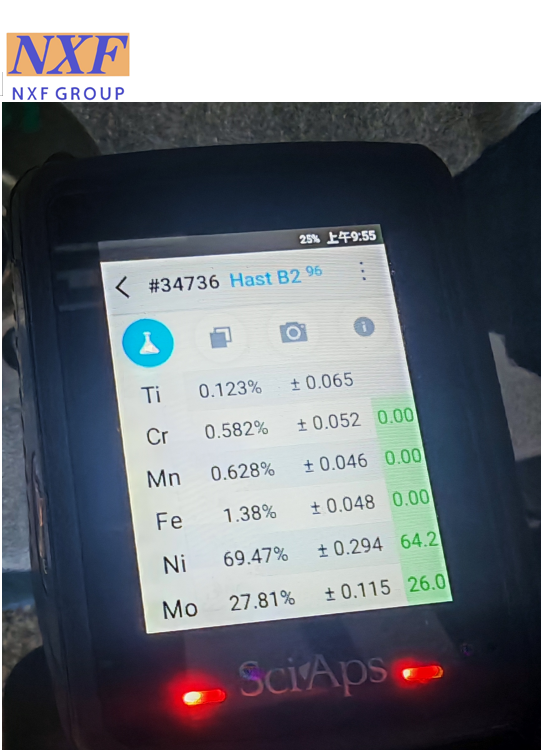
Alloy B2 Introduction:Alloy B2 is a nickel-molybdenum alloy with significant resistance to reducing environments, such as hydrogen chloride gas and sulfuric, acetic and phosphoric acids. Alloy B2 provides resistance to pure sulfuric acid and a number of non-oxidizing acids. The alloy should not be used in oxidizing media or where oxidizing contaminants are available in reducing media. Premature failure may occur if Alloy B2 is used where iron or copper is present in a system containing hydrochloric acid.Industry users like the resistance to a wide range of organic acids and the resistance to chloride-induced stress-corrosion cracking.Alloy B2 resists the formation of grain boundary carbide precipitates in the weld heat-affected zone, making it suitable for most chemical process applications in the as-welded condition. The heat-affected weld zones have reduced precipitation of carbides and other phases to ensure uniform corrosion resistance.Alloy B2 also has excellent resistance to pitting and stress corrosion cracking.
Alloy B2 Applications:Superior resistance to hydrochloric acid, aluminum chloride catalysts and other strongly reducing chemicals. Excellent high-temperature strength in inert and vacuum atmospheres.Hastelloy B2 is a nickel-molybdenum alloy particularly suited for equipment handling reducing chemical environments .Applications in the chemical process industry involving sulfuric, phosphoric, hydrochloric and acetic acid. Temperature uses vary from ambient temperature to 1500°F depending on the environments (please call for technical advice).
Round Bar Introduction:Round Bar is elongated objects with a circular cross-section, made from various materials including carbon steel (such as Q235, 45# steel), alloy structural steel (such as 40Cr, 20CrMnTi), aluminum alloy, stainless steel, copper, etc. The diameter usually ranges from 3-100mm, with standard sizes including Φ5, Φ10, Φ15, etc. Length can be customized as needed, processing techniques include hot rolling, forging, cold drawing, etc. Hot-rolled round rods are highly efficient for mass production, forged round rods are of better quality and commonly used for key components, cold-drawn round rods have smooth surfaces, high dimensional accuracy, and good mechanical properties. They have a wide range of applications, used in manufacturing for making mechanical parts, bearings, gears, etc., in construction for building scaffolding, support structures, etc., also used as support rods or decorative elements in furniture decoration, and in the sports goods industry for making baseball bats, golf clubs, etc. Its history dates back to early human civilization, initially existing in the form of wooden sticks. With technological development, the production process gradually evolved from manual polishing to mechanized production.