
NXF GROUP

Phone/Whatsapp:+8613917160311
Email: info@nxf-group.com
Email: Andrew@nxf-group.com
Email: Alice@nxf-group.com
English
NXF UNS N10276 2.4819/NiMo16Cr15W/C276 OD DN15-1200 Class 3000-9000 Nickel Alloy Forging Technology Socket Welding Cross
2026-06-26 15:13 NXF GROUP
6
Product Description
C276 Introduction
Super alloys or high performance alloys are available in a variety of shapes and contain elements in different combinations to obtain a specific result. These alloys are of three types that include iron-based, cobalt-based and nickel-based alloys. The nickel-based and cobalt-based super alloys are available as cast or wrought based alloys according to composition and application.Super alloys have good oxidation and creep resistance and can be strengthened by precipitation hardening, solid-solution hardening and work hardening methods. They can also function under high mechanical stress and high temperatures and also in places that require high surface stability. HASTELLOY(r) C276 is a wrought corrosion-resistant alloy that resists the development of grain boundary precipitates that degrade corrosion resistance.
The following datasheet provides an overview of HASTELLOY(r) C276.
C276 Forging Technology Socket Welding Cross Introduction
The forging technology socket welding cross is a pipe fitting used for cross-connection of pipelines. It is manufactured using a forging process and has high strength and durability. The socket welding method is suitable for high-pressure environments. Common materials such as 20#A105 and pressure levels such as 3000LB comply with American standards (ASME/API).
The following is a detailed introduction to the forging technology socket welding cross:
1. Definition and use: The forging technology socket welding cross is a hard-core pipe connection fitting with outlets in four directions, used to realize cross-connection of pipelines. Socket welding refers to a connection method in which pipes are inserted and then welded and fixed, which is particularly suitable for high-pressure environments.
2. Materials and performance: Common materials include 20# carbon structural steel and A105 high-temperature alloy steel, which have high strength and pressure resistance. For corrosive media, materials with good corrosion resistance should be selected.
3. Pressure level: For example, 3000LB pressure level indicates the maximum working pressure that the pipe fitting can withstand, 3000LB≈21MPa (210 kgf/cm2), which is suitable for oil and gas and other industries.
4. Standards and specifications: Comply with the "Forged Socket Welding and Threaded Pipe Fittings GB/T14383-2021" standard, including classification, marking, technical requirements, inspection rules, etc., to ensure product quality and safety.
5. Manufacturing and inspection: adopt hot forging or cold forging process, strictly control dimensional and geometric tolerances, conduct type inspection and factory inspection to ensure product density and mechanical properties.
In summary, when selecting a socket welding cross with forging technology, attention should be paid to the material, pressure level, standard compliance, and manufacturing and inspection processes to ensure its safety and reliability in practical applications.
C276 Forging Technology Socket Welding Cross Drawing

C276 Chemical composition and mechanical properties


Factory and Product Pictures
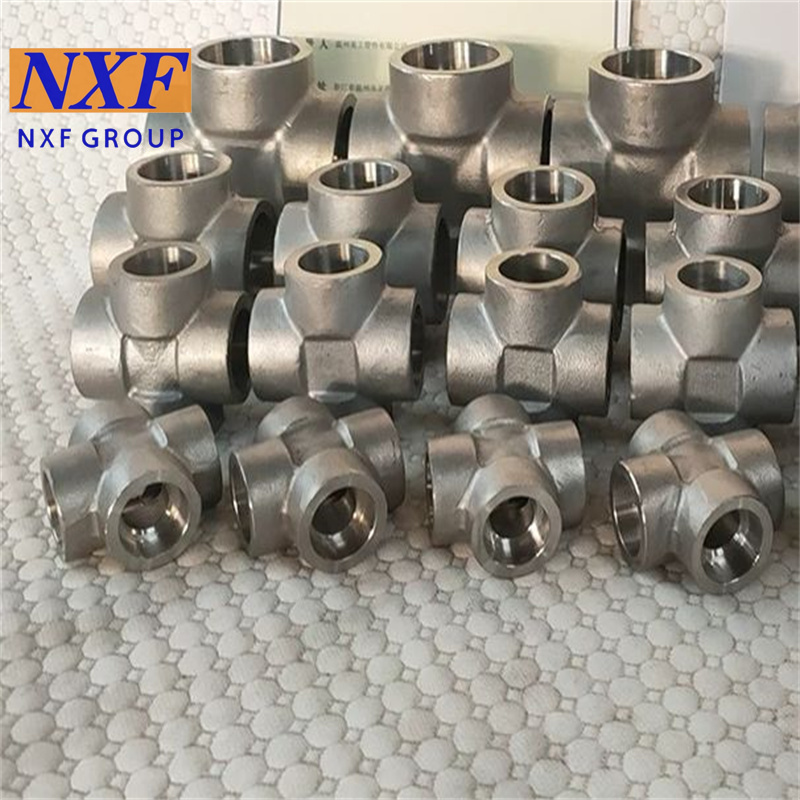
C276 Forging Technology Socket Welding Corss Product Pictures


C276 PMI spectral testing proves


Video of a customer visiting us
Product processing
C276 Forging Technology Socket Welding Cross Processing
1. Raw material preparation and selection: Choose appropriate materials according to the usage scenario, such as carbon steel (such as 20#A105), stainless steel (such as 310S) or copper alloy, etc., to ensure that the material has corrosion resistance, high strength and good welding performance. Inspection: Conduct quality inspection on raw materials to ensure compliance with relevant standards (such as American Standard API/ASME Standard 2) to avoid impurities or defects affecting the performance of finished products.
2. Heating in the forging process: heating the raw material (round steel or steel ingot) to the forging temperature to make the metal reach a plastic state. Press molding: Put the heated blank into the mold through forging equipment, apply pressure to deform it, and form the basic shape of the cross (cross structure, four interfaces). The forging process can improve the density and mechanical properties of materials and adapt to high-pressure environments.
3. Machining and finishing interface: Use a high-precision lathe to process the socket of the cross (the part inserted into the pipe) to ensure dimensional accuracy and surface smoothness, and ensure the sealing of subsequent pipe connections3. Processing of other parts: Trim the overall structure of the four-way, remove burrs and flash, and ensure that the angle of each interface is accurate (usually a 90° intersection).
4. Heat treatment (if necessary) For specific materials (such as alloy steel), heat treatment such as annealing, normalizing or tempering may be required to adjust the hardness, toughness and stress distribution to ensure that the pipe fittings are not easy to crack or deform during use.
5. Surface treatment and cleaning: remove oil stains, scale and other impurities produced during forging and processing. Coating/plating: Some products may undergo surface treatments such as nickel plating and chromium plating to enhance corrosion resistance, improve gloss and extend service life1.
6. Welding performance test and quality inspection Welding suitability inspection: Ensure that the design of the pipe fitting socket meets the socket welding requirements to facilitate subsequent welding operations during pipeline connection. Pressure test: simulate the actual working pressure (for example, 3000LB level corresponds to about 21MPa) to conduct sealing and pressure resistance tests to prevent leakage. Appearance and dimensional inspection: Check whether there are cracks and deformations, and whether the interface size meets the standards (such as American standard cross joint specifications).
7. Packaging and labeling Qualified products should be packaged in rust-proof packaging, and information such as material, pressure level, standard code (such as American standard, national standard) should be marked to ensure that users choose correctly.
Our NXF GROUP advantage as follow
1.Our NXF GROUP have our own factory, and we can control the cost by producing by ourselves. We have a great advantage in price and can give you the lowest price based on best quality.
2.Our NXF GROUP can strictly control the quality. We have production, quality inspection, warehousing and other departments to coordinate and control the quality,Such as PMI and size testing.
3.Our NXF GROUP biggest advantage is 3S service. Small quantity, short time, special materials.
4.Our NXF GROUP have excellent quality certificate system and trademark certificate
5.Our NXF GROUP have a comprehensive after-sales service guarantee, such as the transaction guarantee provided by International Station, as well as remote technical guidance and services.
6.Our NXF GROUP have a well-established logistics support system that can save you both time and money, providing you with a one-stop service.
Packing & Delivery


Company Profile

New XiFei (SuZhou) Business Co.,Ltd is one of the leading and most respected manufacturers in China. Our products include metals, machinery, containers, construction materials, mechanical products, electrical systems, and medical accessories. Established in 1980, XIFEI has been working diligently ever since to embrace the needs of our global customer base.We work to ensure absolute customer satisfaction. Our team has dedicated itself to perfecting our three core components, "Service, Management and Craftsmanship."
C276 Forging Technology Socket Welding Cross Certifications


FAQ
1. who are we?
We are based in Jiangsu, China, start from 2021,sell to South Asia(30.00%),Eastern Asia(10.00%),Mid East(10.00%),Eastern Europe(10.00%),South America(10.00%),Domestic Market(5.00%),North America(5.00%),Northern Europe(5.00%),Central America(5.00%),Africa(5.00%),Southeast Asia(5.00%). There are total about 101-200 people in our office.
2. how can we guarantee quality?
Always a pre-production sample before mass production;
Always final Inspection before shipment;
3.what can you buy from us?
Pipe,Flange,Steel plate,Pipe fittings,Alloy products
4. why should you buy from us not from other suppliers?
Our advantage:3S Service (Small Quantity/Short Time/Special Material) We have our own factories, quality can be controlled seriously.We Specialize in manufacturing about 21 years.We have professional testing department and testing equipment.
5. what services can we provide?
Accepted Delivery Terms: FOB,CFR,CIF,EXW,FCA,DDP,DDU;
Accepted Payment Currency:USD,EUR,CAD,HKD,CNY;
Accepted Payment Type: T/T,L/C,D/P D/A,Credit Card,PayPal;
Language Spoken:English,Chinese,Spanish,Russian
声明:此篇为NXF GROUP原创文章,转载请标明出处链接: https://www.nxf-group.com/h-nd-2038.html
Phone
+8613917160311
Whatsapp
Whatsapp
+8613917160311
Wechat
Wechat
Inquiry
Email
info@nxf-group.com
Inquiry
Inquiry