

Phone/Whatsapp:+8613917160311
Email: info@nxf-group.com
Email: Andrew@nxf-group.com
Email: Alice@nxf-group.com
NXF UNS N10276 2.4819/NiMo16Cr15W/C276 Nickel Alloy Forging THD Square Head Plug & Hexagonal Head Plug & Round Head Bushing
Super alloys have good oxidation and creep resistance and can be strengthened by precipitation hardening, solid-solution hardening and work hardening methods. They can also function under high mechanical stress and high temperatures and also in places that require high surface stability. HASTELLOY(r) C276 is a wrought corrosion-resistant alloy that resists the development of grain boundary precipitates that degrade corrosion resistance.
The following datasheet provides an overview of HASTELLOY(r) C276
C276 Forging THD Square Head Plug & Hexagonal Head Plug & Round Head Bushing Introduction
Core Definition and Classification
Forged pipe plugs are produced by forging processes such as hammering, rolling, and extrusion, which transform metal billets into pipe fittings used for sealing pipeline ports. The main materials include 304/316 stainless steel, alloy steel, etc. They can be classified based on structure and specifications as follows: Structural type: External thread pipe plug (compatible with external threads of pipes), Internal thread pipe plug (compatible with internal threads of pipes), Sealing pipe plug with rubber gasket (enhances sealing performance)Specification coverage: From M8 small diameter to 3000LB high-pressure large diameter, suitable for different pipe diameters of pipeline systems. Common thread standards include NPT, G, BSP, DIN906, etc.
Core application scenarios
The forged pipe plug, with its high strength and high-pressure resistance, is mainly applied in the following industries: Oil and gas pipeline industry: Used for temporary sealing or long-term sealing of ports in oil and gas pipelines and water pipe systems to prevent medium leakage.Mechanical manufacturing/Aerospace: Suitable for hydraulic and pneumatic pipelines of precision equipment, capable of withstanding high pressure and high-frequency vibration conditions.Petrochemical/Energy: In high-temperature and corrosive medium environments, used to seal test ports and discharge ports of process pipelines to ensure system safety.General industrial scenarios: Such as pipeline maintenance in hydraulic and pneumatic systems, used for rapid sealing of ports to prevent medium loss or impurities from entering.


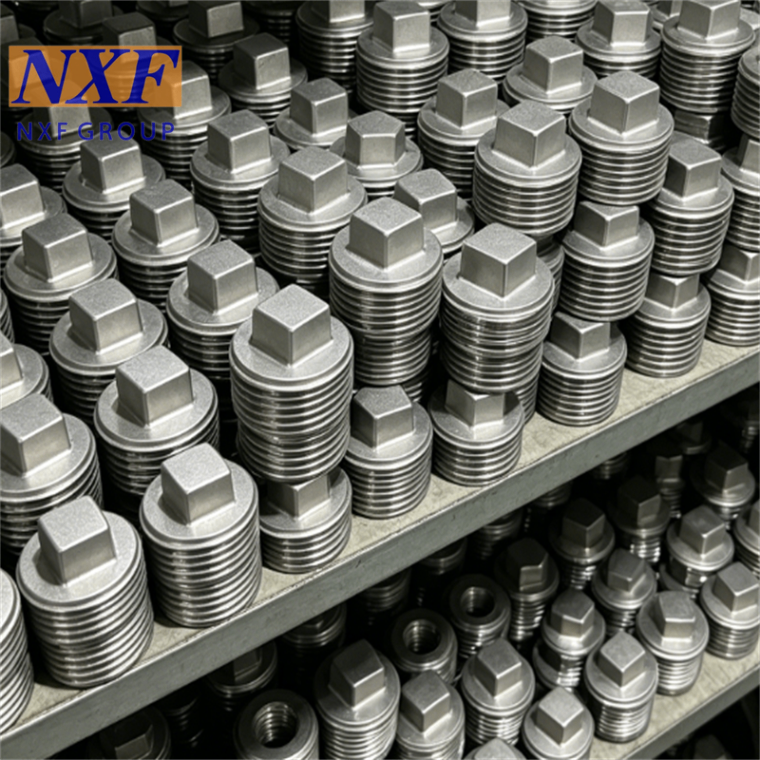


C276 Forging THD Square Head Plug & Hexagonal Head Plug & Round Head Bushing Product Processing
1. Raw material preparation: Select C276 Hastelloy alloy round rods as the raw material. Cut the round blanks of the appropriate length from the rods according to the specifications of the pipe plug, ensuring that the dimensional tolerances comply with the requirements of the forging process.
2. Heating and forging: Heat the blanks to 1150-1200℃ (the forging temperature range of C276), using an air furnace or a protective atmosphere furnace for heating to avoid oxidation and decarburization. Then, through hammering or a press machine, perform upsetting and elongation to initially form the cylindrical shape of the pipe plug, while refining the grains and enhancing the material density.
3. Thread processing: According to the pipe plug's compatible pipe thread standard (such as NPT, G, BSP), process the external or internal threads on the end face of the pipe plug through turning or rolling techniques to ensure the thread accuracy and surface finish, ensuring the sealing compatibility with the pipe.
4. Heat treatment: Conduct solution treatment (heat to 1100-1150℃ and quench in water) on the forged pipe plugs to eliminate forging stresses and restore the corrosion resistance of C276 alloy; for some high-precision pipe plugs, additional aging treatment is required to further enhance hardness and dimensional stability.
5. Inspection and packaging: Conduct size inspection (thread accuracy, outer diameter/inner diameter tolerance), mechanical property tests (tensile strength, hardness), and corrosion resistance sampling tests on the pipe plugs.
Qualified products are polished and deburred, then packaged with anti-corrosion or vacuum packaging to prevent corrosion damage during transportation and storage.
with a one-stop service.


We are based in Jiangsu, China, start from 2021,sell to South Asia(30.00%),Eastern Asia(10.00%),Mid East(10.00%),Eastern Europe(10.00%),South America(10.00%),Domestic Market(5.00%),North America(5.00%),Northern Europe(5.00%),Central America(5.00%),Africa(5.00%),Southeast Asia(5.00%). There are total about 101-200 people in our office.
2. how can we guarantee quality?
Always a pre-production sample before mass production;
Always final Inspection before shipment;
3.what can you buy from us?
Pipe,Flange,Steel plate,Pipe fittings,Alloy products
4. why should you buy from us not from other suppliers?
Our advantage:3S Service (Small Quantity/Short Time/Special Material) We have our own factories, quality can be controlled seriously.We Specialize in manufacturing about 21 years.We have professional testing department and testing equipment.
5. what services can we provide?
Accepted Delivery Terms: FOB,CFR,CIF,EXW,FCA,DDP,DDU;
Accepted Payment Currency:USD,EUR,CAD,HKD,CNY;
Accepted Payment Type: T/T,L/C,D/P D/A,Credit Card,PayPal;
Language Spoken:English,Chinese,Spanish,Russian