

Phone/Whatsapp:+8613917160311
Email: info@nxf-group.com
Email: Andrew@nxf-group.com
Email: Alice@nxf-group.com
NXF UNS S304/ 1.4301/SUS304/Z7CN18-09 Size DN15-1200 Pressure Class150-1500lb Ss304 Stainless Steel Forged Blind Flange
Type 304L is a low-carbon version of 304 stainless steel. It is used for heavy-duty components to improve weldability. Some products, such as steel plates and pipes, may be "dual-certified" materials, meeting both 304 and 304L standards. 304 stainless steel exhibits excellent corrosion resistance in a variety of environments and when exposed to different corrosive media. In environments containing chlorides, pitting and crevice corrosion may occur. Stress corrosion cracking can occur at temperatures exceeding 60°C. 304 stainless steel has good oxidation resistance in intermittent use, withstanding temperatures up to 870°C, and 925°C in continuous use. However, continuous use at 425-860°C is not recommended if water corrosion resistance is required. In such cases, 304L is recommended due to its resistance to carbide deposition. For applications requiring high strength at temperatures exceeding 500°C, up to 800°C, grade 304H is recommended. This material will retain its water corrosion resistance.
Ss304 Stainless Steel Forged Blind Flange Introduction


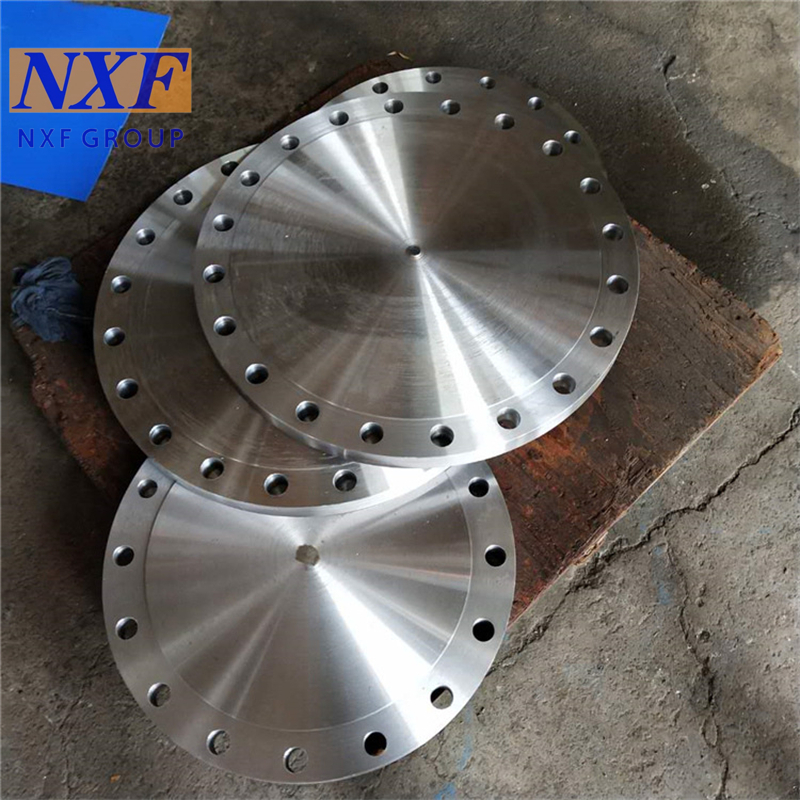


Ss304 Stainless Steel Forged Blind Flange Product Processing
1. Raw material inspection and cuttingSelect national standard 304 stainless steel sheet or forgings, test chemical composition, hardness, and surface quality. Cut the blank according to the flange specification dimensions to ensure material compliance and uniform thickness.
2. Forging / Pressing moldingUse forging or hydraulic pressing technology to press the raw material into the basic shape of the flange cover, increasing material density and strength, and ensuring a regular shape, no cracks, and no layers.
3. Turning and fine processingCarry out end face, outer diameter, and inner diameter processing on the CNC lathe, plane the sealing surface, ensuring flatness and finish, making the blind plate and flange fit tightly and seal reliably.
4. Bolt hole positioning and drillingMark the hole positions according to the corresponding flange standards, precisely process the bolt holes using a drilling machine or CNC drilling machine, ensuring that the hole diameters, distances, and angles meet the standards, facilitating assembly and connection.
5. Chamfering and deburringCarry out chamfering and deburring on the flange edges, hole openings, and sealing surfaces to avoid sharp edges scratching the sealing gasket, improving installation safety and sealing performance.
6. Surface treatmentPerform polishing, acid washing passivation, or wire drawing treatment according to requirements, removing oxide scale and oil stains, enhancing corrosion resistance, and improving appearance quality and rust prevention ability.
7. Dimension and appearance inspectionComprehensively inspect the outer diameter, thickness, hole diameters, sealing surface flatness, and finish, checking for no scratches, cracks, or deformation, ensuring compliance with standard requirements.
8. Pressure test and finished product storageCarry out water pressure or air tightness tests according to pressure levels, clean, rust-proof, package, and label after passing the tests, completing the production process.
3.Our NXF GROUP biggest advantage is 3S service. Small quantity, short time, special materials.
4.Our NXF GROUP have excellent quality certificate system and trademark certificate
5.Our NXF GROUP have a comprehensive after-sales service guarantee, such as the transaction guarantee provided by Alibaba International Station, as well as remote technical guidance and services.
6.Our NXF GROUP have a well-established logistics support system that can save you both time and money, providing you
with a one-stop service.


We are based in Jiangsu, China, start from 2021,sell to South Asia(30.00%),Eastern Asia(10.00%),Mid East(10.00%),Eastern Europe(10.00%),South America(10.00%),Domestic Market(5.00%),North America(5.00%),Northern Europe(5.00%),Central America(5.00%),Africa(5.00%),Southeast Asia(5.00%). There are total about 101-200 people in our office.
2. how can we guarantee quality?
Always a pre-production sample before mass production;
Always final Inspection before shipment;
3.what can you buy from us?
Pipe,Flange,Steel plate,Pipe fittings,Alloy products
4. why should you buy from us not from other suppliers?
Our advantage:3S Service (Small Quantity/Short Time/Special Material) We have our own factories, quality can be controlled seriously.We Specialize in manufacturing about 21 years.We have professional testing department and testing equipment.
5. what services can we provide?
Accepted Delivery Terms: FOB,CFR,CIF,EXW,FCA;
Accepted Payment Currency:USD,EUR,CAD,HKD,CNY;
Accepted Payment Type: T/T,L/C,D/P D/A;
Language Spoken:English,Chinese