

Phone/Whatsapp:+8613917160311
Email: info@nxf-group.com
Email: Andrew@nxf-group.com
Email: Alice@nxf-group.com
NXF UNS S31603 Size DN15-1200 Pressure Class150-1500lb 316L Stainless Steel Forging Technology Socket Welding Flanges
Grade 316L, the low carbon version of 316 and is immune from sensitization (grain boundary carbide precipitation). Thus it is extensively used in heavy gauge welded components (over about 6mm). There is commonly no appreciable price difference between 316 and 316L stainless steel.
The austenitic structure also gives these grades excellent toughness, even down to cryogenic temperatures.
Compared to chromium-nickel austenitic stainless steels, 316L stainless steel offers higher creep, stress to rupture and tensile strength at elevated temperatures.
316L Stainless Stee Socket Welding Flanges Introduce


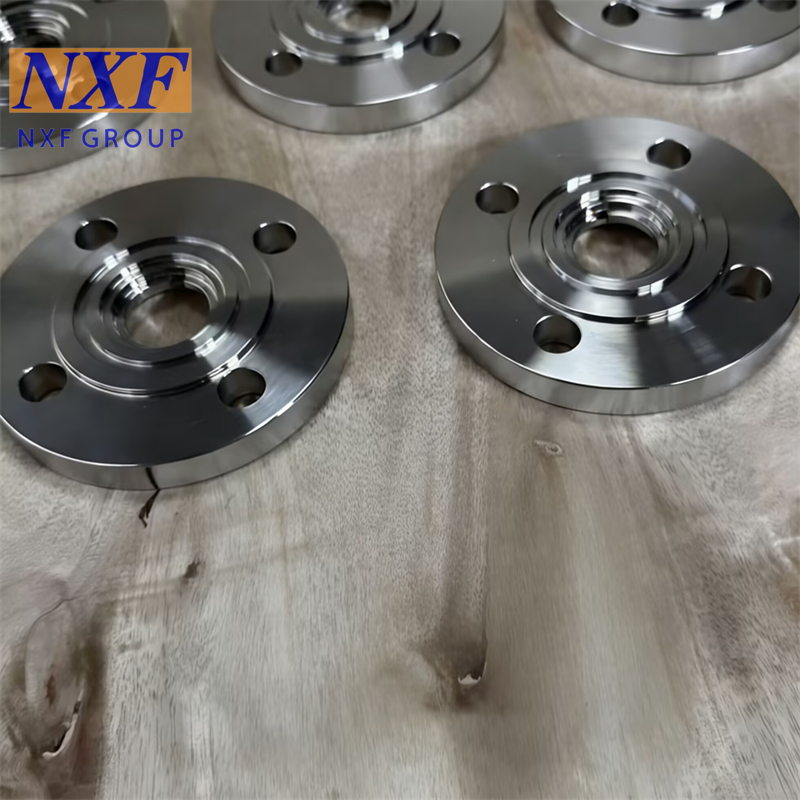


316L Stainless Stee Socket Welding Flanges Product Processing
1. Raw material cuttingSelect 304, 316 stainless steel or carbon steel forgings or round bars, cut the material according to the flange specifications, remove the excess parts, and ensure the accurate size of the blank material, flat surfaces, and no cracks or layers.
2. Forging and shapingHeat the blank material at high temperature and then forge it into shape, making the metal structure dense and increasing the strength and impact resistance. After forging, perform heat treatment to eliminate internal stress and prevent deformation during processing and use.
3. Rough machining on latheCarry out rough machining on the outer circle, end face, back, and center hole of the flange on the CNC lathe, initially form the flange structure, reserve the machining allowance, and ensure stable clamping and unified benchmark.
4. Precision machining of socket jointsPrecision machine the sealing surface and socket groove, strictly control the depth and inner diameter tolerance of the socket hole, ensure the appropriate gap for pipe insertion; at the same time, process the welding groove to facilitate subsequent welding and sealing.
5. Bolt hole processingLocate according to national standards, use drilling machines or CNC equipment to evenly drill bolt holes, chamfer the hole mouth to remove burrs, ensure smooth installation of the bolt, and avoid scratching the sealing gasket.
6. Surface treatmentPerform acid washing, passivation or rust prevention treatment on the flange, remove oil stains, oxide scale and processing impurities, form an anti-corrosion protective film, and improve corrosion resistance and appearance quality.
7. Inspection, marking and storageInspect the size accuracy, depth of socket joints, flatness of the sealing surface and appearance quality, and randomly test the water pressure and air tightness. After passing the inspection, mark the material, pressure, specification, and standard number, package and store.
2.Our NXF GROUP can strictly control the quality. We have production, quality inspection, warehousing and other departments to coordinate and control the quality,Such as PMI and size testing.
3.Our NXF GROUP biggest advantage is 3S service. Small quantity, short time, special materials.
4.Our NXF GROUP have excellent quality certificate system and trademark certificate
5.Our NXF GROUP have a comprehensive after-sales service guarantee, such as the transaction guarantee provided by Alibaba International Station, as well as remote technical guidance and services.
6.Our NXF GROUP have a well-established logistics support system that can save you both time and money, providing you
with a one-stop service.


We are based in Jiangsu, China, start from 2021,sell to South Asia(30.00%),Eastern Asia(10.00%),Mid East(10.00%),Eastern Europe(10.00%),South America(10.00%),Domestic Market(5.00%),North America(5.00%),Northern Europe(5.00%),Central America(5.00%),Africa(5.00%),Southeast Asia(5.00%). There are total about 101-200 people in our office.
2. how can we guarantee quality?
Always a pre-production sample before mass production;
Always final Inspection before shipment;
3.what can you buy from us?
Pipe,Flange,Steel plate,Pipe fittings,Alloy products
4. why should you buy from us not from other suppliers?
Our advantage:3S Service (Small Quantity/Short Time/Special Material) We have our own factories, quality can be controlled seriously.We Specialize in manufacturing about 21 years.We have professional testing department and testing equipment.
5. what services can we provide?
Accepted Delivery Terms: FOB,CFR,CIF,EXW,FCA,DDP,DDU;
Accepted Payment Currency:USD,EUR,CAD,HKD,CNY;
Accepted Payment Type: T/T,L/C,D/P D/A,Credit Card,PayPal;
Language Spoken:English,Chinese,Spanish,Russian